I don't know about you, but the best way I have found to discover new, interesting blogs is to cruise the blog lists of like-minded friends.
For ages my blog list seemed 'broken.' I couldn't add any, the ones I had added after my initial list was made didn't show....... For some reason, the little widget was working today, so I took the opportunity to add a few, hide a few more, and generally did a little house-cleaning. (now if I would get off this computer and do some cleaning of my real house!!!!)
My blog-reading list is a lot longer than the ones that I show here. Some don't post very often, or have political overtones - like food preservation sites that are a little too apocalypse-minded. The ones I have chosen to show are a nice cross section of fiber, friends and food blogs I hope you find as interesting as I do.
Wednesday, October 24, 2012

Saturday, October 20, 2012
Pickled Garlic
SO much garlic! "You must really like it, or you must really like "pickling." Yes to both.
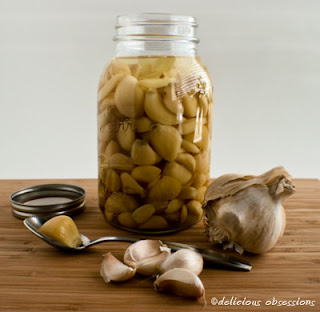
Garlic is so abundant and priced right now, I just couldn't help but take advantage of sales, and add to what's left of the 17 heads of my own garlic I harvested earlier in the summer. Now what to do with it?
There are many ways to preserve garlic - by freezing, in oil, but "pickling" (really fermenting, my new favorite way to preserve food) seems the way to go for me. 1. It's so easy. 2. It only mellows the taste, doesn't really change it. 3. I'll have pre-peeled garlic cloves ready at any time to smash, slice or mince into a recipe. 4. I don't have to can it. 5. It won't take up any of my miniscule freezer space.
During the process, I found the easiest way to peel garlic (by far!) is to blanch it - dunk it in boiling water for 30 seconds or so, then into ice water. Squeeze the root end, and it pops right out of the skin! I was shooting them all over the kitchen until I got the hang of it. The having pre-peeled garlic at the ready is the most appealing aspect of this, I think.
You could eat the cloves as-is once they are fermented, for the health benefits. To each his own. I put a lot of garlic cloves in when I make pickles, and I have found those are very good to eat 'raw.' (did I mention I live alone?)
Put the cloves in a jar, cover with salted water, stopper the top, and leave in a dark place for a month, then into the fridge, where it will keep for at least a year. It's as easy as that. For those who want a bit more detail in their instructions, try this site: http://www.deliciousobsessions.com/2012/09/52-weeks-of-bad-a-bacteria-week-32-lactofermented-garlic-updated-for-the-pickl-it/ I don't have one of the fancy jars she mentioned, nor do I use whey. I just use a canning jar, with a baggie of water in the top of the jar to weigh the cloves down.
Thursday, September 27, 2012
Bringing in the Harvest
If it is true that "In the Spring a young man's fancy lightly turns to thoughts of love," then Autumn is the time when old women's thoughts turn to bringing in the harvest!! I do a little canning, almost no freezing, and I'm interested in other forms of food preservation.
I know, I know, it's been a very long time since I have posted anything, but this summer was the pits. At least a month of 100 degree temps decimated the garden, and work was a bear, taking up all of my emotional energy.
Now that we've had a month of cooler (and sometimes downright chilly) temps and some blessed rain, anything in the garden that wasn't ruined has bounced back.
I pulled up the San Marzano tomatoes today, not because they are done, but because I need the room to put in some fall/winter plants. I got almost nothing off those tomato plants all summer, but when I pulled them out, they were packed with green tomatoes. I will let some ripen inside to use later, and some will go into green tomato salsa. http://www.farmgirlfare.com/2005/09/saving-harvest-green-tomato-relish.html# I think I post this every year. So does the Farmgirl, as it turns out. One of the comments on the post also suggested roasting the green tomatoes (!!) with sweet potatoes.
In a repeat of last year's "haul" photo, this is what I got off my 4 plants. Enough to fill a 5 gallon bucket.

The Corno de Toro peppers (there is a red pimento pepper peeking out of the background) need just a little more ripening. The "sun side" is ripe, but the "shade side" is still green. These are OK, but an improvement over banana peppers? I don't know. I might try both next year to test them side-by-side.

Another reason for pulling out the paste tomatoes is to give my favorite German Pinks as much sun as possible, Hoping to ripen these babies on the vine.

It's hard to appreciate how large these are in this photo. I have at least a dozen 1 to 2 lb. tomatoes still on the plants. German Pinks are a very late/fall variety. There is just no getting around that. It doesn't matter how early the seedlings are started or when they are set out, this plant will only produce the occasional tomato until September. They can go until frost kills the vines. Then the green tomatoes are still fine to bring in and ripen. The lady who gave me these said her family did that every year, and have had fresh tomatoes as late as Thanksgiving!!
My dehydrator has been going day and night for a couple of weeks. I bought the peppers in the photo below at the local farmer's market. 
I have dried peppers, zucchini and yellow squash, but my favorite thing to dry this fall - is greens! I only occasionally eat greens cooked by themselves. I prefer them in something - think any recipe with the word "Florentine" in the title. Any greens can be dried - spinach, kale, chard, turnip ...you get the idea. I dry mine on the lowest temperature available, to preserve as much of the nutritional value as possible. Dehydrating maven Mary Bell suggests powdering them after drying, which is fine, but I like to just lightly crush them into flakes with my hands before storing. They can then be added to any dish while cooking - soups, stews, rice, couscous, pasta - they would be especially good in veggie lasagna.
Another favorite is to buy fresh mushrooms on sale at the store then slice and dry those. They dry especially well. When reconstituting, the liquid makes a great mushroom stock, and they are good in so many things too - like that veggie lasagna. (do you sense a trend here?)
My other new way of preserving is fermenting. Yes, the experiment I talked about in my long-ago previous post went very well, and I have fermented many things since then!

I love these pickles!!!!!! They taste very different from vinegar-preserved pickles, and they are so freakin' easy to make!! I have also done radishes, which I liked a lot -
fermented radishes at the beginning:

photo credit: http://www.seriouseats.com/2012/06/in-a-pickled-fermented-radish-slices.html
And when they're done -

I just wanted to show you that the fermenting processes draw the red out of the radish skins, turning the radish white, and the liquid pink. It looks a little weird, but tastes good!! I also made 6 quarts of sauerkraut, which are in bags in the freezer. I tasted it as I was bagging it, and I think it will be very good.
I didn't like broccoli at all, and I'm not fond of the cauliflower I fermented. I made beet kvass (how-to here: http://thenourishingcook.com/how-to-make-fermented-beet-kvass/ ) which is the liquid drawn off fermented beets. Um......it's an acquired taste...I don't dislike it, but it is different. It is so good for you though, I keep taking a swig now and then.
I made preserved lemons. The instructions I had called the ones with added spices Moroccan lemons, and the plain ones Italian. I made plain.
Since I had to use lots of fresh lemons to get enough juice (unlike the photo above the lemons have to be covered with liquid) I peeled the zest (no pith) off the leftover lemon rinds, I'm steeping them in vodka, and will soon be making my own Limoncello. I'm doing the same with Bing cherries to make homemade Kirsch.
What are YOU preserving this fall, and how?
Saturday, July 14, 2012
Who knew??
I am just as ignorant about food as the next person. I was listening to a report on NPR about someone who was trying to re-create her Grandmother's pickles, with no success. As she read off the recipe, I thought to myself "there's no vinegar in that recipe." Little did I know that real dill/sour pickles are fermented in a salty, herby brine, not canned in vinegar. Who knew?
I don't have enough cucumbers from my wee patch to make a batch, but my local Farmer's Market was my source for a few pounds of pickling cucumbers, and I have everything else here: kosher salt, peppercorns, along with dill, garlic - and maybe a dash of hot pepper - from my garden. I even have a small wild grapevine to provide me with the supply of tannin (leaves) to keep the pickles crispy. So. I'm going to give it a try.

I've been on the internet looking up recipes and instructions. Here are a couple of the good ones:
http://www.learningherbs.com/fermented_foods.html
http://chiotsrun.com/2011/07/30/making-traditionally-fermented-pickles/
If it works well, I may try other veggies. I'll keep you posted.
We've gotten a little blessed rain in the last few days. My frequent watering (I'm afraid to open the water bill) kept things alive, but it was just too hot to set fruit, especially on the tomatoes: "Daytime temperatures above 90°F and night temperatures above 70°F result in reduced flowering and fruit set. There is considerable evidence that night temperature is the critical factor in setting tomato fruit, the optimal range being 59° to 68°F." - source, Cooperative Extension Service. But now that the temps have cooled a little, I am noticing more blossoms.
I picked my first San Marzano tomatoes today, and half of those had blossom end rot. I worked lime into the soil when I planted them, so I am blaming the weather. Nothing wasted though, with the bad end cut off, they were a treat for the chickens.
Little Seraphina is getting better!!!! She has got movement and some strength in her bum leg, and with just a little support from me, she can stand! She has no balance though, and if she tries to stand herself, she falls over. That makes her mad, she squawks, and just keeps trying. She is determined to get better. I am really surprised her sisters don't pick on her, but they are very accepting. The "Mean Girls," Abigail and Gracie were mean to her (and all the Cochins) before, and still are though.
Getting 1 or 2 eggs every day. :)
Holly and Niko got plucked/clipped during the hot weather (even though they are inside and are nice and cool in the a/c) Niko peeled off the whole lower half of his coat to the skin, only needing to be sheared on top. Talk about looking like a rat! Holly was the opposite, plucked bald over her whole back. She turned on her "tude" before I could clip the rest. She was wasn't having it! She was done! So she has looked like a mushroom since. Maybe I'll give her another try today..........after I make pickles.
Sunday, June 24, 2012
The Heat is on!
This is the time of year that I don't like to go outside, unless it's early morning or late evening. It's just too darned hot! I am thankful that so many of my growing veggies and herbs are heat lovers though. Without all this heat, our tomatoes would be, well, those icky pale things you buy in the store.


There is no question that tomatoes in the ground do better than the ones in pots, but the potted ones are producing some fruit too, and that is the important thing.

Lest anyone think my backyard is only for plants.......
On the drying rack under the deck is Bramble's fleece. Bramble is from Boulderneigh in Oregon, a small farm where they are also used to making the most of limited space. They keep a garden, chickens, horses, a pony, dogs, at least one cat, and a small flock of Shetland sheep, all on about 5 acres, I think. The fleece is lovely browns and beiges, although it looks gray in this photo. Michelle seemed concerned I might not like it, since it is the least fine of her sheep. Not to worry, soft and fine are relative terms, and even though she's got sheep that are softer and finer, this one is yummy to me!


If it's possible, I think I've used even more of my small space this year for growing things than ever before. There is a pot on every step, mostly tomatoes and onions. At the top is a tall trashcan with potatoes. They were an afterthought. I had not intended to have potatoes this year, but found some of my home-grown ones sprouted in the bottom of the fridge, so ......... At the bottom of the steps are big tubs on the right, one with leeks, and another with a bush-form of acorn squash. On the left is a comfrey (medicinal) plant, that has been cut back many times already this year. The leaves really make compost break down quickly, and if 'stewed' in a covered bucket, the liquid at the bottom can be used (diluted) as a wonderful fertilizer!

I'm in danger of having so much room taken by plants, that there is no room for me on the deck! Pictured behind the flowers are a pot with two varieties of cucumber, a bush form and lemon cucumber. Also basil, dill, thymes, a tomato and two pots with lavender sharing with cousin rosemary as well as sage. Two varieties of eggplant out of the photo on the left are going gangbusters, as well as two planters of bush beans.

There is no question that tomatoes in the ground do better than the ones in pots, but the potted ones are producing some fruit too, and that is the important thing.

One side of my potager. Tons of stuff growing there. Broccoli, peppers, carrots, tomatoes, chard, onions, garlic, turnips and more. I'll admit it. Times are uncertain. I'm planting more because I have more sense of urgency to do it - even though I couldn't begin to feed myself completely from my efforts, every little bit helps.
On the drying rack under the deck is Bramble's fleece. Bramble is from Boulderneigh in Oregon, a small farm where they are also used to making the most of limited space. They keep a garden, chickens, horses, a pony, dogs, at least one cat, and a small flock of Shetland sheep, all on about 5 acres, I think. The fleece is lovely browns and beiges, although it looks gray in this photo. Michelle seemed concerned I might not like it, since it is the least fine of her sheep. Not to worry, soft and fine are relative terms, and even though she's got sheep that are softer and finer, this one is yummy to me!

I've got half of Bess's fleece soaking in the washing machine. Bess comes from Tanglewood Farm, and her fleece really is the lustrous brown/black as it looks in the photo (link to Bess's name). I'm not sure what it is about that fleece. It has something I've never experienced before in a fleece. Body, maybe? I just know that when I washed the first half, when I gathered it up into may arms, it would just sproing right back when I would lay it down again. I wanted to hug it !!!!
Washing a fleece in a washing machine is a big deal for me. I heard other 'sheepy' friends talk about it, but I just never had the nerve. So, for years I have been messing with small batches in lingerie bags in the sink, in Rubbermaid tubs in the bathtub..........many sloppy, inefficient methods to wash a fleece. This weekend - I don't know why I decided to risk it - with two fleeces I like so much, - but I filled the tub on 'wash' with hot water, turned it off, added Dawn dish washing detergent (which I have always used, although it has it's detractors) and added the fleece, letting it sink into the water. After a while, I turned the washer button to "Spin," which drained the washer without agitating the fleece, and spun the excess water out of it. (I had used the spin part before). I repeated to rinse. - using as many washes and rinses as necessary. No muss, no fuss, no felting, and it did a beautiful job. Why, oh why have I been doing it the hard way all these years?
What about the other animals on the Wren Cottage homestead? The rabbits and cats are lying low, the rabbits loving the air conditioning the cats seeking out any patch of sun they can to bake in. (crazy animals) On the chicken front, it's good news/ bad news. Nearly all of the girls started laying last weekend. It's about time for the hens - they should have been laying long before this. As for Nigella and Jasmine, the new Cochins, they have begun laying, at six months - 2 or 3 months earlier than Dolley did.
The third pullet, Seraphina, is a sad case. A month or so ago, she began to limp noticeably. I checked her thoroughly, and couldn't find any sign of injury or bumblefoot (my first thought). After limping for two days, on the third day, she was down and the leg was paralysed. She still has movement from the hip, but the leg and foot are definitely lifeless. It's warm, so there is circulation. The other leg has movement, and sometimes she flails around like she is trying to stand, but she doesn't seem to be able to coordinate it to stand (even if I hold her up) or try to hop on one leg. My best guess is she had a stroke, or was pecked on the head (I did find the tiniest bit of blood on her comb) so hard she got a brain injury. (that's what I work around all day, so that's the way I think)
So what do you do with a handicapped chicken? I know perfectly well what most people would do, but I could not, will not, take an animal and kill it with my bare hands, say what you will. She eats and drinks well, (I feed her separately so I can watch her and make sure she gets adequate food and water) seems chirpy and perky, and scoots around in her own way. She doesn't seem to be suffering at all, and still enjoys cuddling together with her sisters at bedtime. (they have always preferred that to roosting) I just make sure her vent area stays clean, and make her as comfortable as I can, wondering how I could make a little leg brace or 'walker' for her.
Before you think I've gone completely 'round the bend, I'll leave it there.
That's the latest news from ......Wren Cottage.
Sunday, May 27, 2012
Where have I been?
OK, I haven't fallen off the face of the earth.....
The last couple of months, things have been intense at work, and it probably won't ease up through the summer. Once I get home, take care of the livestock and tend the garden a bit, that's about all I have left, and I just fall into bed - just like most other farmers who work off the farm. :-) For anyone who longs for farm life, that's the reality, even for an urban farm.
I'm enjoying every minute though. My planting is nearly done. About the only thing I have left to do is another planter of bush beans, which will go in after the peas are done, and another go at dill. The first planting didn't germinate. I just don't have the room for pole beans. Last year they made an amazing amount of foliage for no more beans than I got, so I'm going back to bush beans in planters on the deck. I have some 'Hericote Vert" coming up now, and will plant "Tenderpod" later.
I harvested the last of the beets yesterday. I've decided I'm still not wild about beets, although they are OK roasted with other root vegetables. I love beet greens though! I never liked greens (read spinach only, during my northern upbringing). Even after moving south, all the cornbread in the world couldn't make up for the 'slime' factor of greens boiled to death with a ham bone. Then I discovered how to wilt down the greens in a skillet with a little olive oil and garlic (maybe onion), YUM!!
My other "I don't like that vegetable" experiment this year is peas. 'English' peas here, to differentiate from the other things called peas, like blackeyed - actually a bean. Mine have pods and are filling out - though the brutal heat this weekend has me worried. I pulled off a couple of pods the other day and ate the baby peas raw........ they were exquisite! I think I would like them best fresh in a salad rather than cooked though.

New for me are cucumbers, acorn squash, and leeks ......which must be the slowest growing things in the world. I put them in in March, and they are only the thickness of a pencil lead.
Mentally going around the garden, this is what I have planted, besides those already mentioned:
Tomatoes


The roses were pretty but very early this year, and short lived in the warm weather. June is still a week away, and the roses are all done!
This really should be two (or three) posts, but since I've let it go so long.....
Last week was the Kentucky Sheep and Fiber Festival - our 3rd year. I am SO glad it was last weekend, instead of this one. The temps weren't nearly as bad as this scorching weekend, and for once we avoided having a thunderstorm! I took my camera, and didn't take one picture!!! Anyone reading this who has not been to KSFF, will just have to content themselves with the photos they will post on the website of this year's festival. My set-up was super easy and the same as I have done every year.
We had some new vendors, including people who were just visitors previously! One was Fiber Crazy Studio.and Rabbitry , who also had Angora rabbits. I met Ben last year, when he brought by a blue Junior English doe by for me to see. Some of his foundation stock came from the same Rabbitry as mine, Somerhill Farm, so he was happy to see my Holly and Ivy - Aunties to some of his bunnies. Since he had lots of products (and rabbits) to sell, I didn't bother bringing anything. I did my usual talk promoting the rabbits as an alternative fiber animal, especially for city folks, and if they wanted a bunny, yarn or fiber to spin, I would send them over to him. It worked great. New bunny owners got a packet of info from me and a member application for the United Angora Rabbit Club!
Even for us who show, it's still about the shopping! I bought a burl cherry wood Nostepinne (ballwinder) from Sistermaide. Do I need such a thing? Of course not, but I've always been a sucker for hand-made, hand-turned, beautiful wood items (that's why I have several hand-spindles I rarely use). She sells at shows and on Etsy, as do a number of our vendors, so you can buy from them all year round!
I also bought some black alpaca/wool blend roving, and a skein of hand-dyed olive green alpaca/wool blend from Dianne at Tanglewood Farm. (thank you so much for the bonus!!!!) To give you an idea of the quality of Dianne's wool, she took Champion Fleece, both this year and last year (which I bought!) at the Festival! She has been breeding sheep for a long time, blending breeds to get optimum wool for the spinner and knitter, and her results are fantastic. She usually shows at the KY Wool Fest in Falmouth KY each year also, so if you're in the area in October, her booth is not to be missed.
That's all for now from Wren Cottage......
The last couple of months, things have been intense at work, and it probably won't ease up through the summer. Once I get home, take care of the livestock and tend the garden a bit, that's about all I have left, and I just fall into bed - just like most other farmers who work off the farm. :-) For anyone who longs for farm life, that's the reality, even for an urban farm.
I'm enjoying every minute though. My planting is nearly done. About the only thing I have left to do is another planter of bush beans, which will go in after the peas are done, and another go at dill. The first planting didn't germinate. I just don't have the room for pole beans. Last year they made an amazing amount of foliage for no more beans than I got, so I'm going back to bush beans in planters on the deck. I have some 'Hericote Vert" coming up now, and will plant "Tenderpod" later.
I harvested the last of the beets yesterday. I've decided I'm still not wild about beets, although they are OK roasted with other root vegetables. I love beet greens though! I never liked greens (read spinach only, during my northern upbringing). Even after moving south, all the cornbread in the world couldn't make up for the 'slime' factor of greens boiled to death with a ham bone. Then I discovered how to wilt down the greens in a skillet with a little olive oil and garlic (maybe onion), YUM!!
My other "I don't like that vegetable" experiment this year is peas. 'English' peas here, to differentiate from the other things called peas, like blackeyed - actually a bean. Mine have pods and are filling out - though the brutal heat this weekend has me worried. I pulled off a couple of pods the other day and ate the baby peas raw........ they were exquisite! I think I would like them best fresh in a salad rather than cooked though.

New for me are cucumbers, acorn squash, and leeks ......which must be the slowest growing things in the world. I put them in in March, and they are only the thickness of a pencil lead.
Mentally going around the garden, this is what I have planted, besides those already mentioned:
Tomatoes
- German Pink
- San Marzano
- Yellow Pear
- Kamo - regular globe type
- Little Finger - long, oriental
Onions - large and scallions
Shallots
Carrots - Red Chantenay
Blueberry - Duke, just beginning to ripen
Strawberries - 2 unknown varieties, both everbearing and June bearing.

Chard
Cucumber
- Bushmaster
- Lemon
- yellow bell
- pimento
- Corno de Toro (long, stuffing type)
Broccoli
And this doesn't include the perennial plants and herbs. Not bad for such a small space!!

The roses were pretty but very early this year, and short lived in the warm weather. June is still a week away, and the roses are all done!
This really should be two (or three) posts, but since I've let it go so long.....
Last week was the Kentucky Sheep and Fiber Festival - our 3rd year. I am SO glad it was last weekend, instead of this one. The temps weren't nearly as bad as this scorching weekend, and for once we avoided having a thunderstorm! I took my camera, and didn't take one picture!!! Anyone reading this who has not been to KSFF, will just have to content themselves with the photos they will post on the website of this year's festival. My set-up was super easy and the same as I have done every year.
We had some new vendors, including people who were just visitors previously! One was Fiber Crazy Studio.and Rabbitry , who also had Angora rabbits. I met Ben last year, when he brought by a blue Junior English doe by for me to see. Some of his foundation stock came from the same Rabbitry as mine, Somerhill Farm, so he was happy to see my Holly and Ivy - Aunties to some of his bunnies. Since he had lots of products (and rabbits) to sell, I didn't bother bringing anything. I did my usual talk promoting the rabbits as an alternative fiber animal, especially for city folks, and if they wanted a bunny, yarn or fiber to spin, I would send them over to him. It worked great. New bunny owners got a packet of info from me and a member application for the United Angora Rabbit Club!
Even for us who show, it's still about the shopping! I bought a burl cherry wood Nostepinne (ballwinder) from Sistermaide. Do I need such a thing? Of course not, but I've always been a sucker for hand-made, hand-turned, beautiful wood items (that's why I have several hand-spindles I rarely use). She sells at shows and on Etsy, as do a number of our vendors, so you can buy from them all year round!
I also bought some black alpaca/wool blend roving, and a skein of hand-dyed olive green alpaca/wool blend from Dianne at Tanglewood Farm. (thank you so much for the bonus!!!!) To give you an idea of the quality of Dianne's wool, she took Champion Fleece, both this year and last year (which I bought!) at the Festival! She has been breeding sheep for a long time, blending breeds to get optimum wool for the spinner and knitter, and her results are fantastic. She usually shows at the KY Wool Fest in Falmouth KY each year also, so if you're in the area in October, her booth is not to be missed.
That's all for now from Wren Cottage......
Sunday, April 8, 2012
And Then There Were Five.......
Bringing the new pullets home Friday brought my total number of chickens to 6 - a number manageable only because they are bantams, and so small.
But........
Dolly was fine yesterday morning, but by early afternoon was very sick, with labored breathing and, much more than lethargy - she couldn't hold her head up and only opened her eyes a couple of times. I immediately put everyone on Sulmet in their water, and began forcing some down Dolly with a syringe. She was much worse by last night, and this morning when I got up, she was gone. (None of the other birds are showing any symptoms)
To be fair, she had a bout with something similar, but less severe, about 2 or 3 weeks ago, and snapped out of it overnight on the Sulmet - which I kept everyone on for a week after that. When the new birds came in, they went right into a quarantine cage, and I practiced rigorous 'hand hygiene." (I do work in a hospital, after all) I don't believe in coincidences, so I figure she either picked up a virus they brought in, especially if she was in a weakened condition from her earlier symptoms, or something regenerated her illness from before.
But why is it always your favorite?
She was quite a little character, and will be missed.

Subscribe to:
Posts (Atom)